Persistent Vision, Sculptures from 2011-2016 is Presented by Kiki Frayard
Step into Curtis Patterson’s studio, where bronze and steel morph into amplified ancestry
Hilliard Presents Studio Sessions
Artist Curtis Patterson describes his deep connection to his ancestry, which drives his art and the hidden messages within it. A Shreveport native, he returns to Louisiana with fifteen years of bronze and steel sculpture drawn from African diasporic motifs and the rhythms of jazz.
From his studio in Atlanta’s West End, Curtis Patterson details how art and African American history shaped him and how he translates the experience into teaching others. Through his studio practice and years as a professor, he has built on the legacies of those who came before him while paving the way for those who come next. Persistent Vision, Sculptures from 2011-2016 is on view at the Hilliard Art Museum through February 20, 2027.
Watch the video and then read more about his approach to expanding important legacies through art.
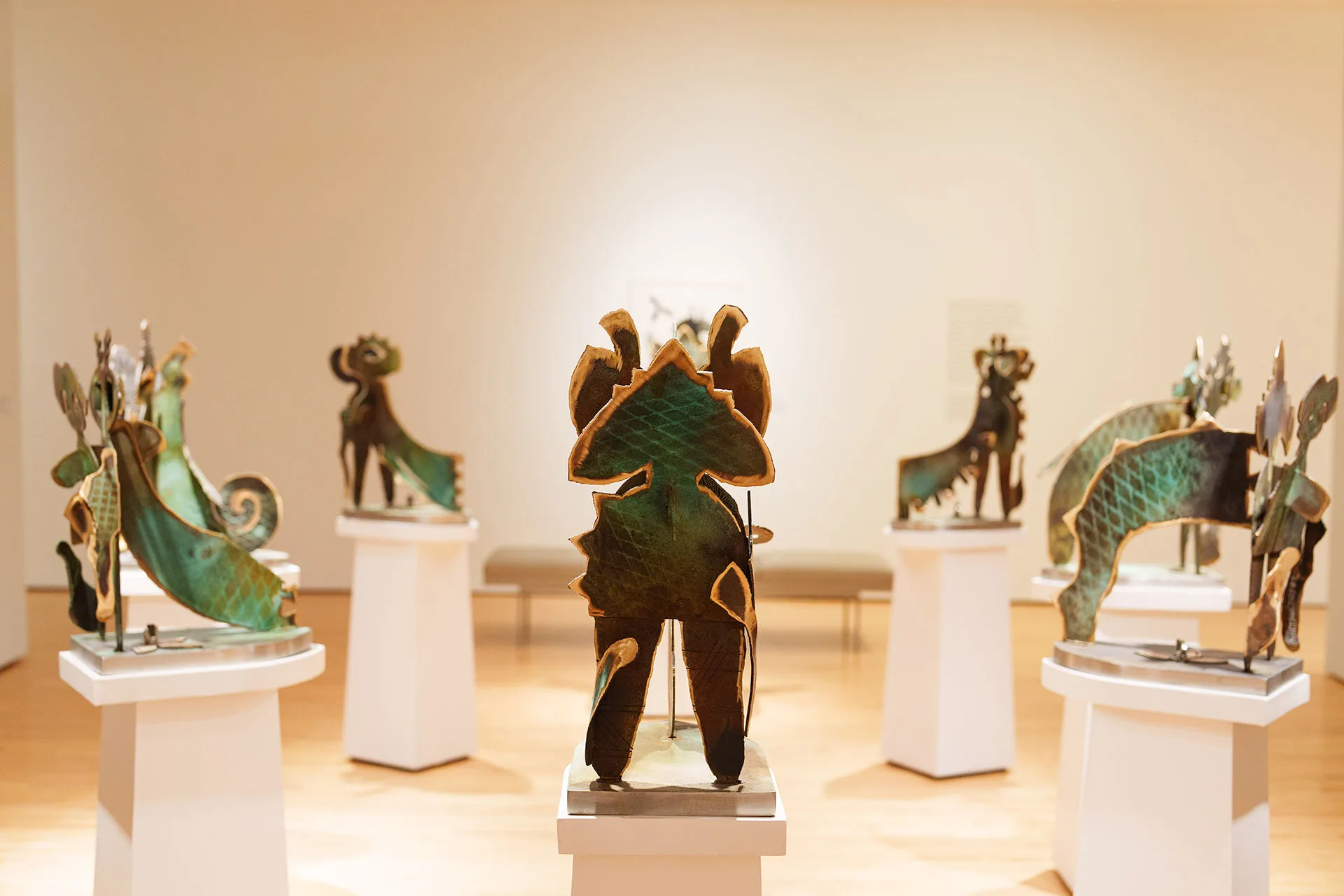
Curtis Patterson — Persistent Vision, Sculptures from 2011 – 2026. Hilliard Art Museum.
Intentional Yet Abstract
Can you start by introducing yourself and describing what you do?
My name is Curtis Patterson. I’m a sculptor. I’ve been making sculpture now for about 50 years. I received my first commission from the city of Atlanta in 1977 from the Bureau of Cultural Affairs. I not only make sculpture, but I also taught it for 30 years at the Atlanta College of Art, now Savannah College of Art and Design (SCAD).
I’m working on a body of work called The Great Migration, which is, in essence, about African Americans moving from the South to the North, the Midwest, and the West. Between 1970 and 2010, about six million African Americans moved as part of the Great Migration. And the other series that I’m continuing work on is called Shango’s Friends. It’s based on Shango, an African Deity, who is the God of fire, thunder, and justice. Shango is a figure with the double axe on the head. I use the double iron as an analogy of domestic and manual labor. The Iron appears extensively in my work, in both my two-dimensional and three-dimensional pieces.
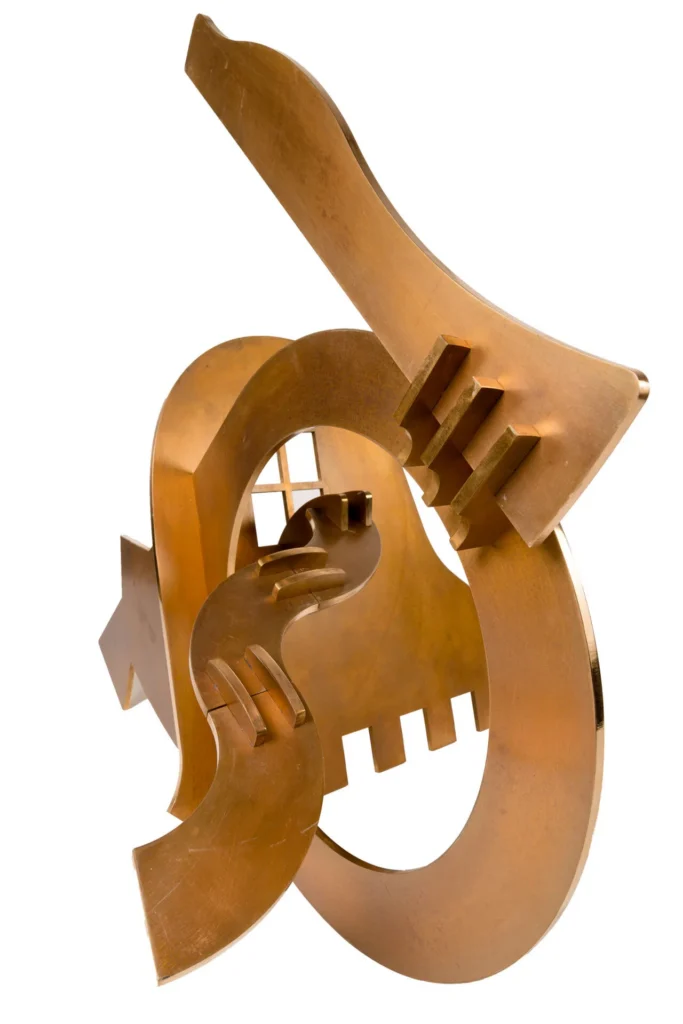
Curtis Patterson, Monk’s Moods (Rocker Series), 2018. Courtesy of the artist and Laney Contemporary. © Curtis Patterson.
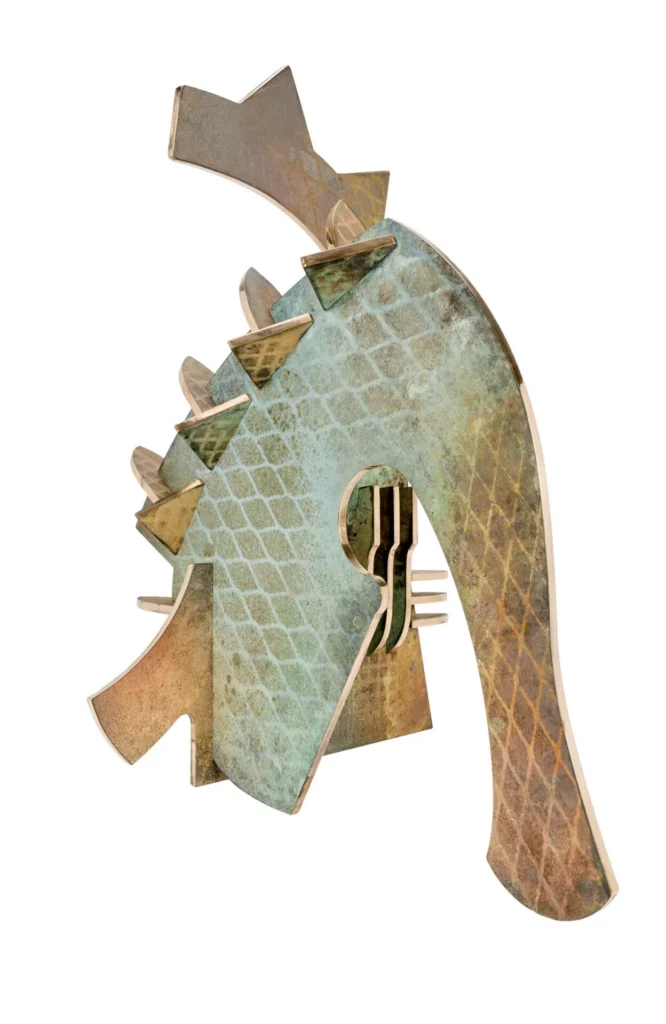
Curtis Patterson, Cold Front (Rocker Series), 2021. Courtesy of the artist and Laney Contemporary. © Curtis Patterson.
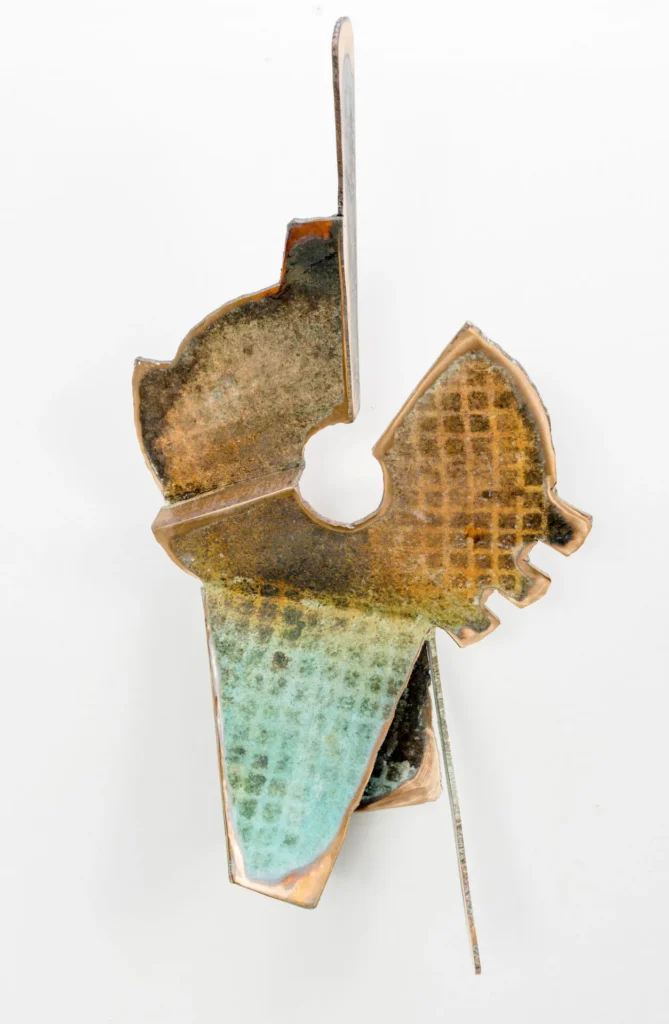
Curtis Patterson, July (Diasporic Reflections Series), 2021. Courtesy of the artist and Laney Contemporary. © Curtis Patterson.
Would you say that you’re exclusively a sculptor or does your work embody more than sculpture for you?
I’m a sculptor. I studied painting and drawing in undergrad. One day I took a ceramics class and made a vessel. When I made art in two dimensions, I always struggled to place the shadow correctly. I remember the day I made this vessel; I was sitting by a window, and the sun was coming in. As I made this coiled pot, the shadow fell on the table in just the right spot. And that was really kind of an “aha” moment for me. I’d been trying to draw and paint the shadow and place it right for a few years, and then all of a sudden, this happened. And that was the beginning of me really wanting to do more work with my hands.
Abstraction Across Forms
There’s a lot of movement in your work. Do you enjoy the physicality of sculpting, and does it come naturally?
I really enjoy the physicality of making it. I am influenced by music and especially jazz. I really like the spontaneity and improvisational aspects. Often, listening to jazz encourages me to improvise in my work. It really stimulates the atmosphere in my studio.
What jazz musicians do you listen to on the speakers in the studio while working?
Some of my favorite jazz musicians are from the earlier jazz periods. I listen to a lot of Thelonious Monk, John Coltrane, and Miles Davis. I hate to name names because I don’t wanna leave anybody out. But I think jazz can be so transformative. I remember listening to a John Coltrane song called “Alabama.” It was about four young girls who were murdered in Alabama in a church. I remember listening to that and reading the cover. I actually shed a tear while listening, and it was really so moving. He expressed something that made me feel very emotional. That was really a transformative moment for me.
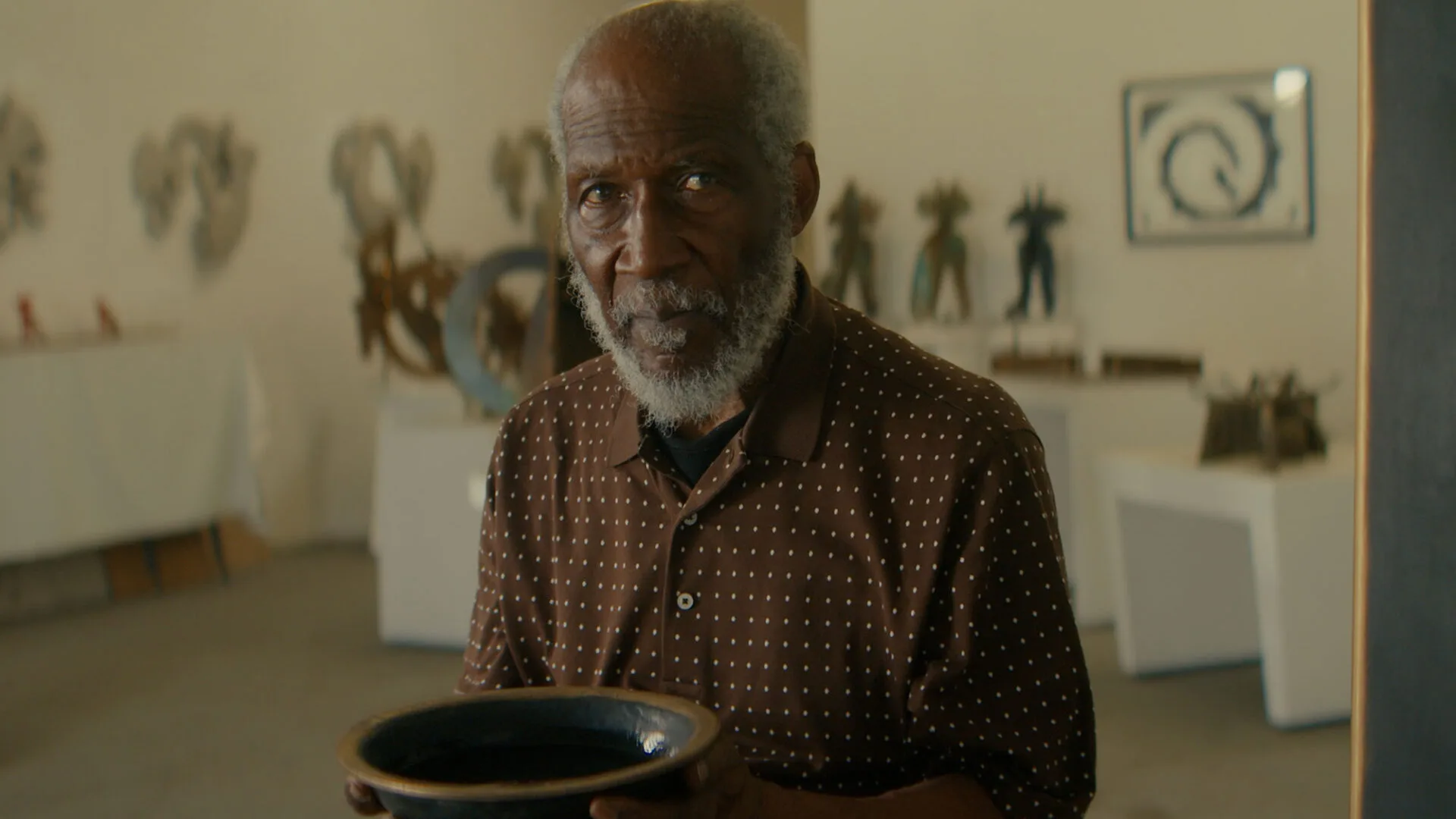
Film still of Curtis Patterson in his Atlanta Studio, 2026.
Ancestral Influences
Can you describe the connection you have to your ancestors?
I’m inspired by trying to do more to elevate the African American cultural experience. I feel like so much has been done by African Americans that has not really been acknowledged as it should be in the history books. And I’m trying to facilitate that by creating art that gives breath to the significance of the contributions made by people of African descent.
Why have masks become so prevalent for you?
Masks are prevalent for me primarily because it’s my reference to African art and also they feed the abstraction in my art. African art utilizes multiple-headed figures because tradition states the head is the most important part of the body. So, therefore, it should be a greater part as opposed to the Western concept, which is more naturalistic. We’re looking at a lot of things that are done naturalistically, but I think there are ways to simplify with abstraction. I use a lot of symbolism in my work.
Creating to Connect Communities
I’ve heard you say, “art has the ability to bridge gaps.” Is there a bridging happening between time, between places and people, when you’re talking about the iron – but you’re also using the African Art of ancient times?
When views oppose each other, art can bridge gaps. For example, I did a piece for a community about 30 miles from Atlanta. It was based on George Floyd’s murder. The community wanted to do something that would make people of color feel comfortable visiting. It was a predominantly white community. So they commissioned me to do a piece that would offer a sense of welcoming and belonging. I did this piece called Serenity for Shango for that site. And it’s been well received both by the community and the people who visit. That’s an example of bridging time and space.
Can you talk more about the public artworks that you’ve created?
I’ve done a number of commission pieces in various places around the states. One of my first pieces was for the Atlanta International Airport, for a musician named Rasan Roland Kirk. The piece is called Bright Moments, which is actually the title of one of his songs. I created a piece for Jesse Owens at Ohio State University, symbolizing the four gold medals he won in the Olympic Games. Another work titled Spiral for Justice was to honor Roy Wilkins and that’s located in St. Paul, Minnesota on the state capital grounds. There are 46 elements in the spiral, and that represents 46 years of his service as executive secretary of the NAACP. And most recently, I did a piece for Andrew Young here in Atlanta, which aims to illustrate his accomplishments made during his lifetime.
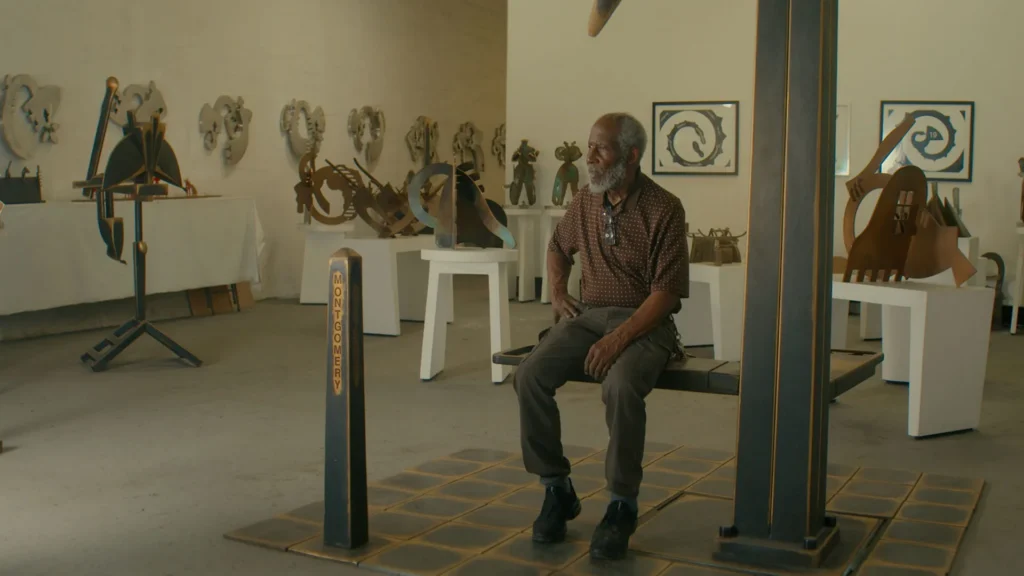
Film still of Curtis Patterson with Montgomery Bus Stop in his Atlanta Studio, 2026.
Opening A Liminal Space
There is an element of surprise and discovery in your works. When an iron is picked up, or a bench is lifted, what does this offer viewers of your work?
My piece for Rosa Parks, called the Montgomery Bus Stop (1989), is a large-scale abstract sculpture. I wanted to create an environment that illustrates how courageous she was for not giving up her seat. The two benches have a handle on each of them. If you’re so inclined to take the handle and lift it, there is an inscription under it by Mary McLeod Bethune that says, “We are the heirs. We’re the custodians, rather, but also the heirs of a great civilization.” And then on the other bench it says, “Reserved for Rosa Parks.”
I think there’s something about discovery. Usually when you go to a gallery or museum, you’re not supposed to touch work. I don’t mind people touching my work. If you lift the bench or an iron with a handle – and you find that there’s a poem under it or some information about the piece, I just think that is so rewarding to the person who made that discovery. If you’re not so inclined, hopefully there’s enough visual information for you to appreciate the work.
Does art create a space for your ancestors to breathe anew?
Yes, much of the work that I’ve done has been commissioned by public entities, and that has a great purpose. But this piece, Montgomery Bus Stop (1989), was a self-initiated commission because I felt that what she did was so courageous that she needed to be sought out and, through art, do something new for us. That’s why I initiated the work myself. I thought she deserved further acknowledgment for that act.
From Paper to Product
Can you describe your process of making work?
When I’m getting ready to create a composition, I will start out with a simple sketch. Once I have a drawing of the silhouette, I take cardboard and actually compose the piece. After the cardboard, I’ll take those parts and transform them into metal. I’m using a slot-fitted technique with notches in the cardboard so I can put the pieces together. I can see them before they are fabricated, then I am ready to move into metal.
Your work lives in the abstract and asks viewers to engage physically, whether that’s in the outdoor public space or while walking around a piece in the gallery. What do you envision or hope the viewer takes away from that engagement?
I have what I call a “sweet spot” for my works – that is an ideal view. The only object that I know of that has a sweet spot from all angles is maybe a sphere because it’s completely round. But when you’re making an object that’s not completely round, there’s often an angle that is perceived as the most complementary, and there’s also an angle that is not as desirable as others. So oftentimes when I see photographs of my work that somebody else has taken, and it’s not what I consider my “sweet spot” – if they take it from their sweet spot – that confirms for me that the piece is successful.
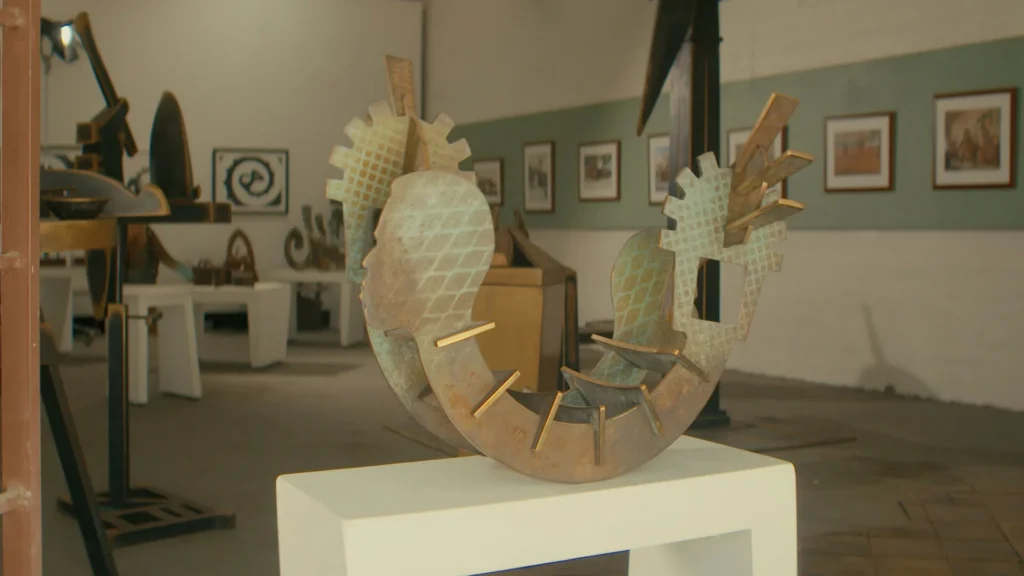
Film still of Curtis Patterson’s Rocker series in his Atlanta Studio, 2026.
Generation to Generation
What does teaching offer you as a practicing artist?
I taught for 30 years at the Atlanta College of Art, now Savannah College of Art and Design (SCAD), and before that I taught six years in the public school system. Teaching is an exchange, and I learn an awful lot from the students. It’s really been wonderful to work with so many students who have gone out and had tremendous careers themselves – in many instances far greater than my experience. I’m very pleased to have been a part of their development.
Do the ancestors speak to you while you’re working?
Yes, and I hope that what I’m doing will serve as a testimony of some of the significant contributions that have been made by people of African descent. I feel far too little has been done to recognize those contributions in the history books. So what I’m trying to do is create work that honors people who I feel have been so significant in developing our culture. I also know that African Art has been a catalyst for many contemporary artists. What I’m trying to do is extend that, and hopefully somebody will continue that extension.
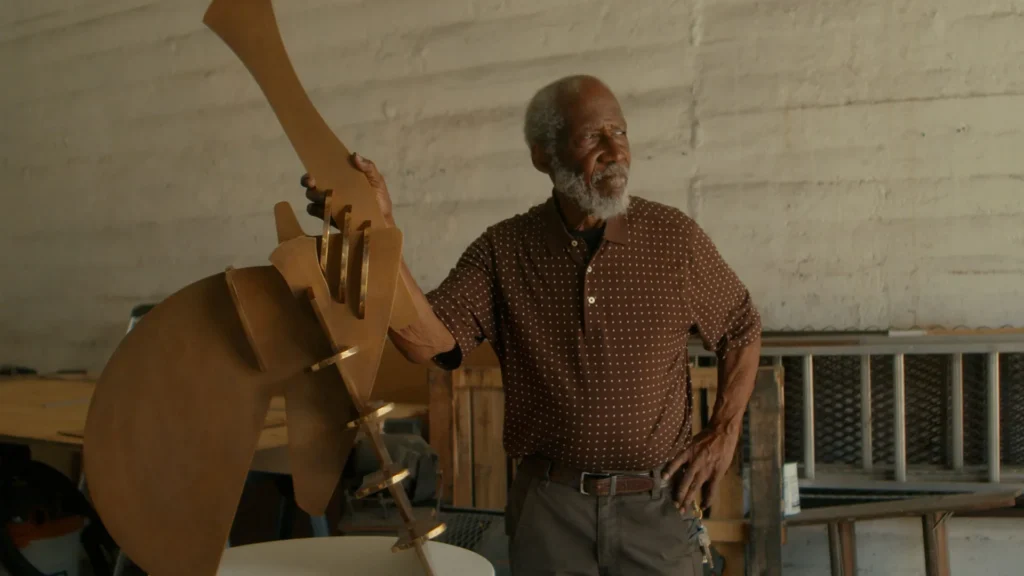
Film still of Curtis Patterson in his Atlanta Studio, 2026.
A Living Art Legacy
Can you talk about what you have learned over all these years of art making?
I’ve learned that, even though it is hard work, I enjoy what I do. Being acknowledged or celebrated for what I do is really amazing to me. That is a lot of encouragement for me to continue. I also enjoy talking with people about my work in public spaces and galleries alike. Not that I have so much to say, but I’m a good listener. I’m interested in what communities feel about the work. People are really very excited to talk about how they feel about art.
What would you tell an emerging artist today?
I would tell an emerging artist to keep making art. I find a lot of fulfillment in creating, working, and paying attention. I would encourage anybody who’s beginning to work to try to fulfill themselves. I mean, it’s something that you can do for a lifetime.
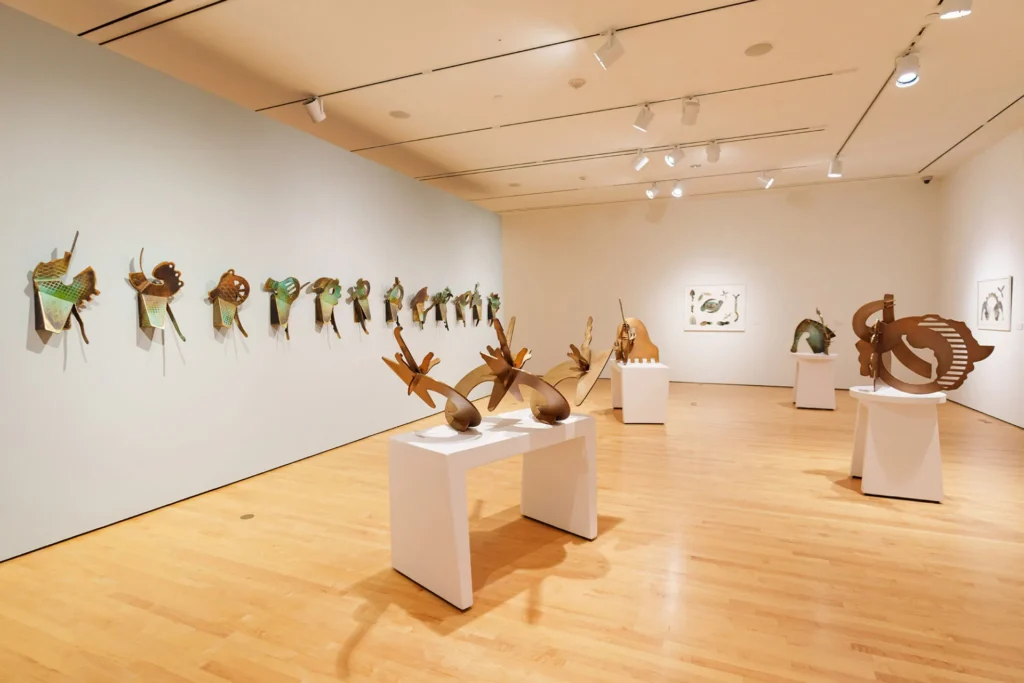
Curtis Patterson — Persistent Vision, Sculptures from 2011 – 2026. Hilliard Art Museum.
Acknowledgments
Persistent Vision, Sculptures from 2011-2016 is Presented by Kiki Frayard
The Hilliard Art Museum extends sincere thanks to Curis Patterson and Melissa Messina for inviting us into his Atlanta workspace for Studio Sessions. His method reminds us that abstraction can set form free and communicate a new understanding. The Hilliard is honored to bring these works in Persistent Vision, Sculptures from 2011-2016, which span the last fifteen years to Louisiana.
Special thanks to Louisiana makers, Allison Bohl DeHart (ULL Alumna) and Alejandro Moreno, for their collaboration on this studio session video. Aubrey A. Daval is Engagement Director of the Hilliard and Creative Director of Studio Sessions.
