If There Be Nothing New, But That Which Is is Presented by Kiki Frayard
Rachel Libeskind on her practice of deconstructing archives to engage in a new truth
Hilliard Presents Studio Sessions
Artist Rachel Libeskind reflects on what drives her to create—the burden of approximately 600,000 new images being generated each second and the cross-section that comes from engaging with an archive across time.
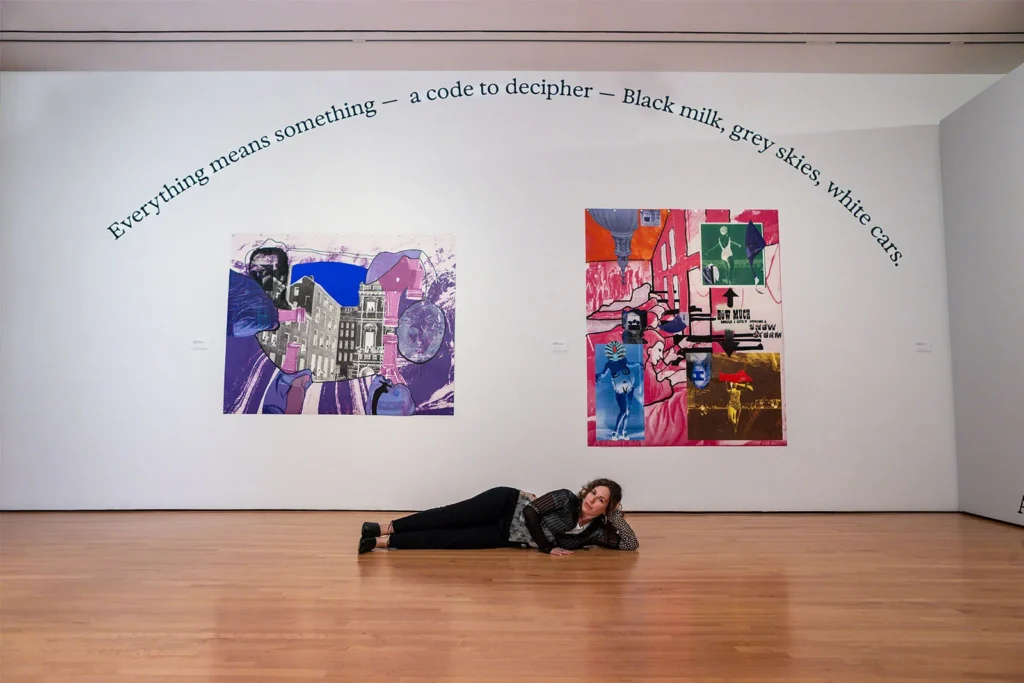
On the occasion of the opening of her solo show of previously unseen large-scale collage works at the Hilliard, Rachel Libeskind shares what haunts her as an artist and her process of working with the living archive. In the accompanying Studio Session video, watch Rachel create a live collage on-site at the museum. If There Be Nothing New, But That Which Is on view through August 15, 2026, at the Hilliard Art Museum, examines the limits of legibility and visibility within the mundane.
In this conversation, she talks about the relief of discovering collage, her process of deconstructing image archives, and the influence of growing up in Berlin.
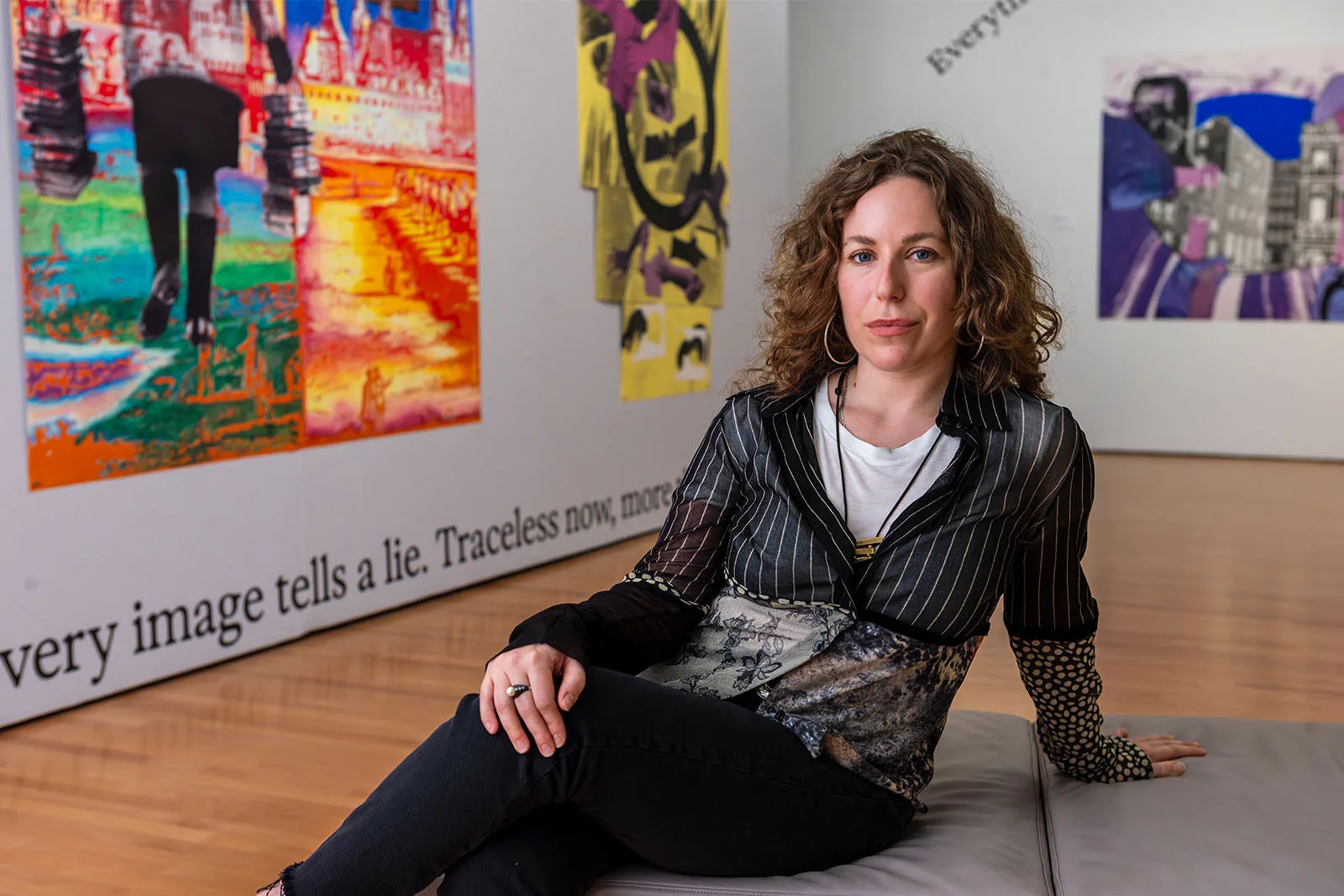
Can you start by introducing yourself and describing what you do?
I would say that I’m an artist of many trades. I make theater, performance video, sound, and books. I make anything that I want to make. I have a studio practice and a performance practice.
The Endless Archive
Can you talk about the burden you feel regarding the endless amount of images being produced in today’s archive?
I am just sort of haunted by the archive of images that exist in the world that is bigger than anybody can really wrap their head around. We have the incredible, endless world of digital images generated by people engaging on social media and creating archives on the internet, from all sorts of different sources. Also, there is the physical analog world of photographs, which has, in some ways, been left behind. I have always been sort of called to the cause to rescue, to save, or to intervene – maybe to inspect – what is hidden or what can be found in images that seem to be discarded. That is one of the main things that drives me and all of my work.
You’ve mentioned that every second, approximately 600,000 new images are generated on the internet. Tell us more about how this statistic has become an artistic driver.
Yes, it’s true that an obscene amount of images are being produced–largely by people taking photographs and putting them on social media or creating new images to go on places like websites. So you can imagine that in a minute, you’ve got 36 million new images. And what do we do with all of that? There’s individual meaning in each image, but I think understanding a cross-section of the world we live in through a slice of that archive is a very important endeavor. That’s what I’ve chosen to do with my life. I mean to use the act of looking to try to make meaning beyond just being overwhelmed.
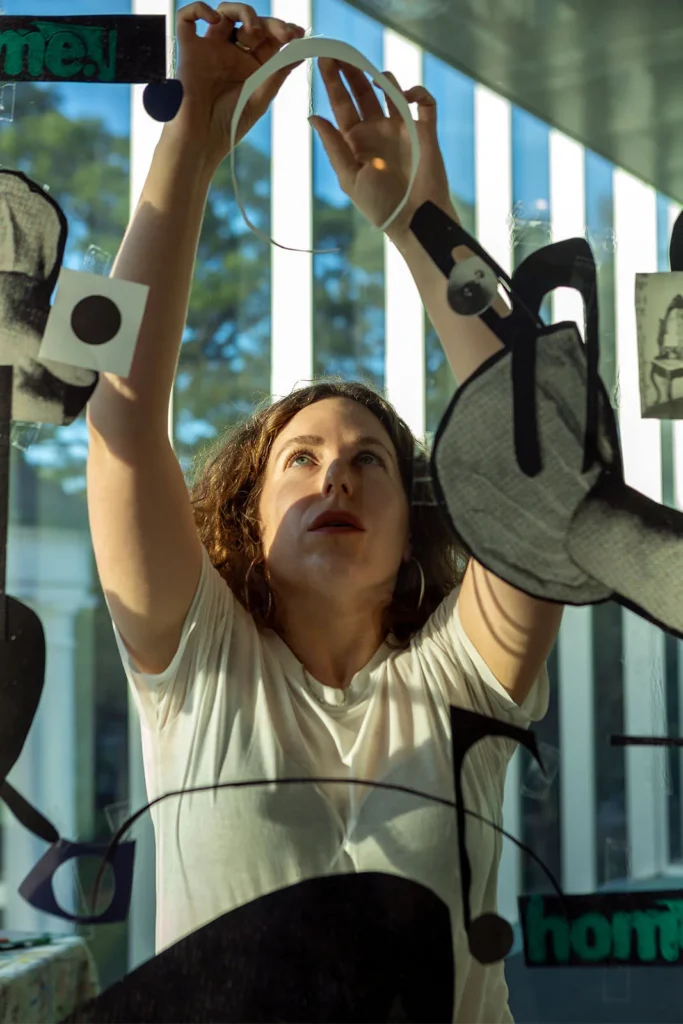
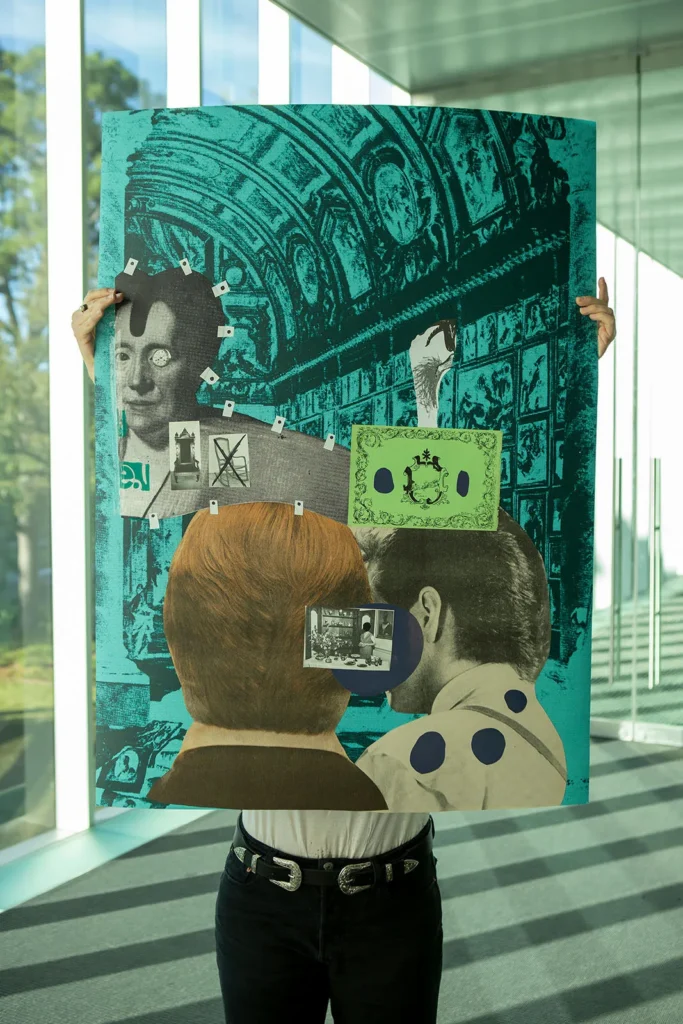
You talk about the assault of images currently flooding into our lives. Can you tell us how you are interested in organizing or making sense of this volume?
As human beings, on a psychological level, we are always trying to make sense of the order and meaning of things that happen to us.
Why did this happen?
Why am I like that?
Why did I have those thoughts?
What did that interaction mean?
Why do I like this image more than that one?
There’s a kind of endless order-making. In the end, actually, I think it really goes nowhere. I think we all try to make order, and it’s sort of a fallacy. It’s a part of being human engaging and wrestling with the past. Through the practice of collage, I’ve found some relief.
An Intimate Trust
There are a few of your films on view in the exhibition. Would you share about your process in making films?
I do make films, but I don’t shoot any of my own footage. Honestly, it’s the greatest hack because I love films. I really wanted to be a filmmaker. So, I edit films and make scripts, but I ask others to self-tape footage of their lives. I love that I can write to 30 people and ask, “Can you make a video of yourself?” and they will. It’s always so interesting to watch. Also, people really interpret my request very differently. Some participants take it really seriously and send me 15 minutes of footage, whereas others might give 15 seconds. The process involves the interpretation – how they interpret it. The other element is that they use their phones and know they’re filming themselves for me, but they have no idea what the final product will be. There is such an intimate trust in that.
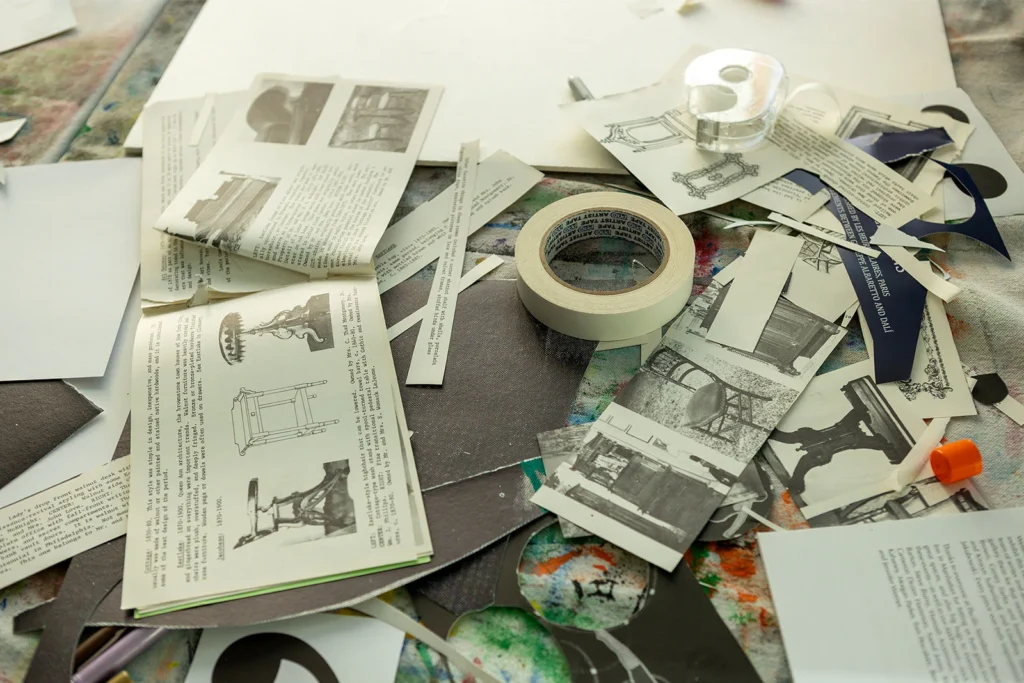
What personal archives or collections do you have currently?
I make archives that are very serious. I’m collecting photographs from the 1940s that are in a box, and I’ve never used them. There are all sorts of ongoing parallels in my process, such as archive-making that has fed my projects. I do think a lot of artists do that all the time. In fact, I think we all do it all the time. So, it’s not just the archive, because the archive itself is an order. It’s something denominated by time or by form, but what’s much more interesting to me is to make my own archive and then make work out of that sort of strange amalgam that perhaps doesn’t make sense to everyone logistically or conceptually. I seek to pull out something driven by the subconscious, something much less obvious than what’s on the surface.
No Barrier to Entry
Can you talk about discovering collage?
I would say collage was my first foray into the freedom of possibility. I mean, that collage showed me that making something can give your life meaning. I grew up making a lot of art in a very artistic home. I would be in my dad’s studio, an architecture studio with a wood shop and lots of scraps, old blueprints, and magazines being thrown out. I spent every single day there after school. I’ve asked myself a lot in my life, as I’ve gotten older, why I didn’t just make paintings, and why everything has to start from something that already is.
There was something powerful about transforming a scrap of wood into a talisman or an old wooden box into a bed for my dolls. Kids are so naturally inclined to that kind of beautiful repurposing and reimagining of materials. Naturally, the older I got and the more seriously I took making art, the more I realized that collage was my version of a sketchbook. I was visually working out things that were on my mind and in my emotions.
There’s no barrier to entry with collage. You know, Nora Ephron famously said, “Everything is copy.” I think about it every day. Everything is collage, right? Everything in the world is accessible to us, and you can kind of make whatever you want now. Collage is a deeply therapeutic practice for anyone to do at any time.
The Poetry of the Mundane
What draws you to the mundane?
I think it was Marcel Duchamp who said, “Yesterday’s newspaper is tomorrow’s toilet paper.” We create so much trash in our world, and the mundane is in that, right? Every day there will be a new material object, a new image, or a new headline. So, how do we make meaning of our lives in the now? Sometimes life is full of a boring set of rituals that cannot be elevated to anything philosophically beautiful or spiritually meaningful. So I am deeply fascinated by the way ritual slips into our lives without us noticing. There is the ritual of brushing your teeth, making your bed, or walking your dog. We share these experiences universally.
There’s a practice to it, and we return to the mundane all the time. I think there is actually a deep poetry in those events, and especially when we think as an artist in the context of an institution. I think about the digital world and the realm of AI, and yet, we all still go home and brush our teeth. There’s something I find deeply comforting about sharing these rituals in contrast to the burdens of creation and consumption. They’re so quiet and poetic to me, so they appear in my work.
Acknowledge the Dissonance
What are some images that you recall from childhood that you still live in?
So I grew up in Berlin right before the wall fell, and then the East and West united. There were so many remnants of this world that had been shut off to my family. There was this visual knowledge, and then there was also this sort of promise of the 90s, of big billboards, and a colorful aesthetic. However, I grew up in a very post-Cold War kind of environment. I used to collect old Soviet books and photographs of Stalin and Lenin sold by flea market sellers.
I had such an acute sense, even as a child, that this was something really important. At once, a photograph of Stalin, which you had previously used as an object to face when going to jail, was now something I was buying for ten cents. There was a lot of refuse historical trash that I grew up around, which made me question a lot about the tides of history and how quickly they change. Sitting in history class as a kid, I remember thinking, “We know everything can change so fast, how are we sitting here learning?” When the wall fell, East Germans had a completely different idea of what the last 50 years of history were. They’d been taught a different history, a different sense with a different lens. I’m not here to say which is right or which is wrong, but to acknowledge the dissonance.
Can you share with readers the story of your art teacher and the moment your confidence in improvisation was solidified?
I share this story because I never know what I’m going to make. I know what materials and mediums I’m going to work with, and I try to set some parameters for myself, but I never have a specific image in mind and I try to lean into that magic. But when I was in elementary school, I was in an art program, and the teacher asked me, “What are you going to do today, Miss Libeskind?” And I said, “well, you know, I’m not really sure. I’m just going to start drawing and see what happens.” And he was so incensed, it was Germany in the 1990s and he berated me, gave a lecture to the class about how I was an example of wastefulness, and I remember he said to me, “What do you think? That there’s just a little man inside your fingers, and he’s going to decide what happens,” And I said, “Yeah, that’s exactly what I think.” Actually, that’s what I think even now. I come back to that all the time because the act of making is deeply improvisational, especially when you make with your hands.
A Matter of Size
Can you tell us about how you arrive at scale in your work?
I have an unfortunate problem, which is that I’m only five feet tall, and I have to make work that’s always bigger than me. That’s its own burden that a heavy, large work seems to be the thing I want to make. That’s part of what makes you feel alive and connected to the spirit of magic and the flow of art-making. It’s very physical and fun to make such large works that are bigger than me.
The Living Studio
Tell us what the secret is to accessing that magic and flow – what is your advice to future artists?
I have perfectionist tendencies that can really get in my way, so I try to shut it all down. I am a big believer that the more you try to control or think about what you want to make, the further away you’re going to get from some essential truth in yourself. I think that’s the key to the act of making for anyone, making anything. I would say believe and trust that you are actually just channeling something else that you can’t control, that you don’t even know what it is. Whether that’s God or spirits or hauntings – it doesn’t really matter. It’s just a flow of energy.
I’m very verbal and also like to control things, and that’s why I make collage in that I like to control images. It’s a contradictory part of my process to try to play, and sometimes it works, then sometimes it doesn’t. In that process, because it’s hard to have endless trust, some days you are overcome with the voices of self-doubt and self-sabotage, all the things everyone in the world deals with. I always tell myself, “Everything can be repurposed.”
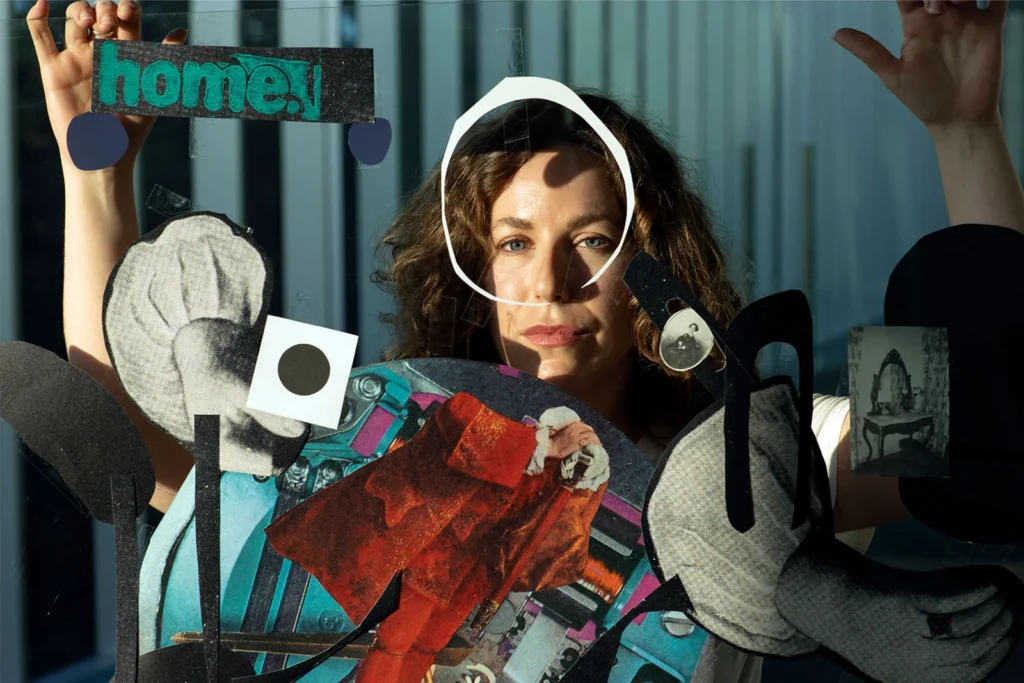
Curators will come into my studio and be horrified. They see how close the finished object is to being splattered on or destroyed by something else. So, I always say, “If you like it, you’ve got to take it out of the studio because if it stays here any longer, it might become something else.” It’s a little bit like alchemy. If it gets too close to the boiling cauldron, it’ll get burned. I definitely think of the studio as a lab, and I’m the alchemist.
Acknowledgments
If There Be Nothing New, But That Which Is is Presented by Kiki Frayard
The Hilliard Art Museum extends sincere thanks to Rachel Libeskind for visiting the museum and creating a live collage for Studio Sessions. Her reflections remind us of the living archive that is our own lives and the palpable act of transforming our reality through engagement with the arts. Her large-scale works in the exhibition, If There Be Nothing New, But That Which Is deconstruct recognizable moments and reconstruct them into new visual frameworks, bringing visibility and intention to the all-too-often overlooked rhythms of everyday life.
Special thanks to Allison Bohl DeHart, ULL Alumna and MakeMade for their collaboration on this studio session video and photography.
