Meet Jonathan Boelkins, the Hilliard’s New Curator
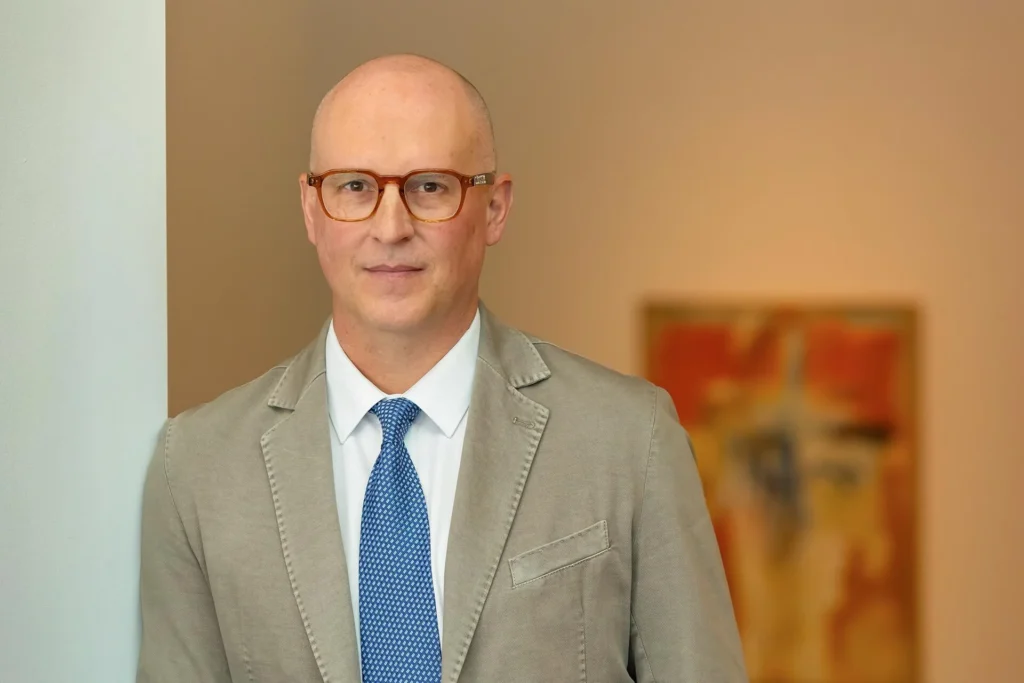
Jonathan Boelkins wants the Hilliard’s galleries to work like portals: a way to travel to other times and places without leaving Lafayette. This fall, he joined the museum as its Curator. In his role, Boelkins will shape the exhibition program and oversee the museum’s permanent collection, the only one of its kind in southwest Louisiana. His first exhibition for the Hilliard, drawn from that collection, opens in spring 2027.
Boelkins brings a career that spans architecture and exhibition design, publishing, and higher education. Most recently, he organized and designed the exhibition for PORCH: An Architecture of Generosity, the United States Pavilion at the 19th Venice Architecture Biennale, in Venice, Italy, the most prestigious design exhibition in the world. He also designed A South Forty, a survey of contemporary architecture and design in the American South, now on view at the National Building Museum in Washington, D.C. He co-edited Radical Practice: The Work of Marlon Blackwell Architects, winner of a 2023 PenCraft Book Award, and spent a decade on the faculties of the University of Arkansas Fay Jones School of Architecture and Design and UL Lafayette School of Architecture and Design. He holds a master’s degree in advanced architectural design from Washington University in St. Louis, where he was a Danforth Scholar, and bachelor’s degrees from the University of Arkansas and Geneva College.
He arrives at a moment of momentum. Under Executive Director Molly Rowe, attendance at public programs has doubled in the past year and a half, and the museum’s digital programs have won top international awards. The renovation of the museum’s A. Hays Town building is underway and will nearly double the Hilliard’s capacity for community and educational programs. And for the first time in the museum’s history, every object in the collection is being photographed, digitized, and documented.
“A university museum should be where a region’s most important questions are asked in public,” says Rowe. “Curators who think like scholars and build like designers are rare, and Jonathan is both. I look forward to thinking and working alongside him as we build the next chapter of the museum.”
In his first weeks on the job, Boelkins talked with us about where he comes from, what an architect brings to a museum, and his first impressions of the collection.
Where are you from, and what did you look at growing up that still shapes how you see?
I was born and raised in eastern North Dakota, a landscape that remarkably looks very much like southern Louisiana, flat with extensive wetlands and farm fields framed by treelines. My mother taught everything as an elementary school teacher, including art, and she recognized and encouraged my early love for drawing, painting, and making things. We moved to western Pennsylvania for my high school years. My aunt who lived there was an extraordinary painter and she took me to local art classes and to the Carnegie Museum of Art in downtown Pittsburgh. That swirl of the city, the art, and the architecture has never left me. I remember the stair in the Scaife Lobby of the museum like it was yesterday – long treads and low risers slow you down while you walk past Sol LeWitt’s Wall Drawings, as light comes through the trees in the courtyard. Otherworldly.
What does your experience as an architect bring to your role as a curator?
It gives me a deep appreciation for the interrelationship between the quality of space and light and the work on display, especially when it’s done well, and it’s certainly done well here at the Hilliard. We have a world-class museum that’s a joy to experience.
Beyond that, I had great teachers and mentors in architecture who continuously affirmed the importance of art, and of drawing and making, especially by hand as it is critical to seeing, in the Annie Dillard sense. They continuously introduced artists to me whose work and writing influenced generations of architects, from Robert Irwin to Mary Miss, whom I had the great honor of working with early in my career.
The Hilliard’s permanent collection runs from ancient Egyptian artifacts to the work of living Louisiana artists, and every object is now being digitized. What are your first impressions of the collection, and what do you hope people discover in it?
One of the most powerful experiences I ever had was in the curatorial spaces of the Clyfford Still Museum in Denver (another truly great art museum building) where I got to see freshly unrolled canvases that no one had seen since the artist painted them originally. I realize I’m in a rare position where I now have the ability (and the responsibility) to simply walk into the archives and open drawers and racks and look around. When I do that, I always have a very real sense of the hand and the body of the artist contacting and creating the work and how deeply personal that is. My hope for the digitization of the collection is that we communicate that same connection to an ever-wider audience, to share the beauty and wonder of work that spans millennia.
To me, the collection defies easy explanation or definition, and that is a great point in its favor.
The Hilliard strives to be regionally rooted and globally engaged. What does that mean to you, and what will it look like in the galleries?
I’m pleased to say that a museum with those aspirations picked great architects (EskewDumezRipple of New Orleans) to help make that happen, ones who believe deeply in balancing the global and the local into what we’ve come to call the “glocal.”
This approach takes the best of each and combines them into something strangely familiar, something slightly foreign but still comforting, and I think there’s great power and possibility in that. To me it’s like the coastal landscape, the watershed of the Mississippi River gathers most of the country and empties into the Gulf, birds migrate from the furthest reaches of North and South America, our sugarcane and rice are sent out across the country and the world. Why should we be any different? Why should art be any different?
The art inside has the same if not an even greater capacity to explore these relationships, to understand the connection of southern Louisiana’s extraordinary history, landscape, and culture to the wider world. I hope the galleries will feel like portals into other times, places, and dimensions, opportunities to travel without leaving Lafayette.
To me, the collection defies easy explanation or definition, and that is a great point in its favor.
Once the renovation of the A. Hays Town building is complete, the Hilliard will work across two buildings. As an architect, what conversations do you see between them, and what becomes possible that was not before?
Modern architecture is often seen as a rejection of history, but we all know that just isn’t true, largely because it isn’t possible. The best contemporary architects know their history – Frank Gehry and Peter Eisenman understood their debt to Bernini and Borromini and the 17th-century Baroque.
To me, architecture that provokes conversations – about history and culture, about proportion and materials, about space and light, about response to climate and landscape – is of immense value and fertile ground for exploration through art.
As Finnish architect Juhani Pallasmaa writes, “Buildings and cities are instruments and museums of time. They enable us to see and understand the passing of history and to participate in time cycles that surpass individual life.”
My hope is that the Town building will help us feel that flow of time, to draw art out of the Hilliard’s galleries, into the plaza, onto its porches, and across its lawn to fully inhabit the site.
Why should a student who has never set foot in the Hilliard care that it is here?
I would also like for students to know that they while the museum may at first seem formal and inaccessible, that in reality it celebrates the work of artists and creative people who are persistent and deeply humane, people who embrace the essence and enduring challenges of life at their most fundamental levels and who respond with optimism and beauty. I also want students to know that the museum is a place where people are free to dream and to imagine how things might be otherwise, how they might be better, how the good life and the just city are realized. It is therapeutic to me and I hope to share that.
What is the best exhibition you have seen in the past few years? What did it do that stayed with you?
The Giacometti Gallery at the Louisiana Museum (the name is a nice coincidence) in Denmark and was overwhelming. The space itself is extraordinary, two stories and overlooking a pond surrounded by willow trees. The quality of natural light is amazing.
What struck me was how comparatively little was needed to fully command the room, just a few figures and one painting. Helen Frankenthaler’s Milkwood Arcade and its burst of color is juxtaposed against Giacometti’s figures that are dark, both in their material and spirit, and it brings it all to life. It can’t be improved.
